
Culture creates value: what a Hospitality Leadership Panel says about the business case for culture
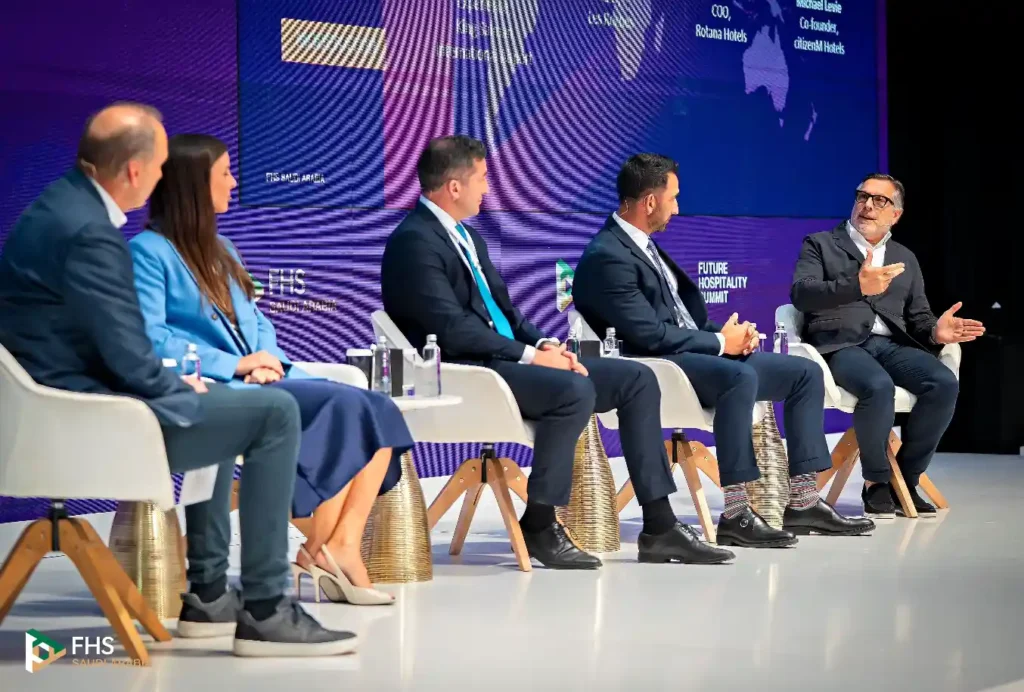
At this year’s Future Hospitality Summit, a panel of senior hospitality leaders sat down to argue a case that many in the industry still treat as a soft, secondary concern: that culture (how people are led, trained, recognised and treated) is not a nice-to-have alongside the balance sheet. It is the balance sheet. The session, titled “Culture Creates Value: How Leadership and Engagement Drive ROI, Brand Strength and Asset Performance,” ran just under 40 minutes and brought together four executives whose portfolios span hotel operations, education, design-led hospitality and aviation.
The conversation was moderated by Andre Wiringa, Founder and CEO of Start Reverse BV, who opened by inviting his panel to the stage: Carlos Diez de la Lastra, Chief Executive Officer of Les Roches, the Swiss hospitality management school; Michael Levie, Co-Founder of citizenM, the hotel brand known for reinventing the mid-market guest experience through design and technology; Miriam Palà, Guest Experience Director at King Salman International Airport in Saudi Arabia; and Eddy Tannous, Chief Operating Officer of Rotana Hotel Management Corporation, one of the Middle East’s largest hospitality groups.
Between them, the panellists represent almost every point where “culture” gets tested in hospitality: the classroom where future hotel leaders are formed, the design studio where a brand’s personality is built into a building, the operations floor where thousands of employees deliver a promise every day, and, in Palà’s case, a setting outside the traditional hotel altogether, where the discipline of guest experience is being imported into one of the world’s newest and most ambitious airport projects.
The Business Case, Not Just the Feel-Good Case
A recurring thread through the discussion was the insistence that culture and engagement aren’t just about morale: they show up directly in return on investment, brand equity and asset performance, the very metrics that owners and investors care about. Early in the conversation, panellists pointed to the scale of the opportunity in human capital, with one speaker noting bluntly that the statistics around it are “massive,” even without wanting to “do a deep dive” into the numbers on stage.
This is a notable shift in framing. For years, hospitality conferences have discussed “employee engagement” and “service culture” as HR topics, bolted onto the real conversation about occupancy, RevPAR and asset value. This panel deliberately fused the two: the argument was that culture produces the numbers owners actually track, rather than sitting beside them.
Get inspired by the full panel discussion
Talent Selection as the First Culture Decision
Alignment, "Common North," and What Actually Drives People
Discussion of asset performance and airport-scale hospitality brought a phrase into focus: alignment on a “common north.” For an operation as complex as an international airport, where retail, security, airlines, ground handling and hospitality all intersect, Palà’s contribution emphasised that culture at scale starts with getting every stakeholder oriented toward the same destination before operational details are even discussed. It’s a useful reframing for any large, multi-stakeholder hospitality asset, not just an airport: culture, in this reading, is fundamentally a coordination problem before it’s a training problem.
The panel also circled a more human question: what actually motivates people to perform, beyond compensation and perks. One exchange, without getting ahead of itself, pointed to something more intangible as “what attracts” people to an organisation and keeps them engaged, hinting at intrinsic motivators like meaning, recognition and belonging rather than transactional incentives. Later in the session, the panel returned to this idea explicitly, discussing what “really drives people” and cautioning against gimmicks, flagging, almost as an aside, that engagement isn’t about novelty stunts (the group specifically joked about not resorting to a literal “flying monkey” to win people over). The point landed as a broader critique of performative culture initiatives that generate a moment of buzz without building anything durable.
Authenticity, Recognition, and the Small Things That Signal Culture
As the conversation moved toward its second half, the panel dug into what makes culture credible rather than cosmetic. Authenticity was described as something that “has to be built in” from the beginning, not layered on top of a brand after the fact through a values poster in the back office. That is consistent with citizenM’s own brand story, where design, technology and a distinctly informal service style were built together from day one rather than retrofitted.
Recognition also came up as a lever that’s often underused. The panel suggested that people who feel genuinely recognised, not just paid, are the ones who carry a brand’s culture forward, particularly at the front line where a company’s values are actually tested in front of guests.
Toward the end, the discussion got refreshingly tactical. Rather than staying at the level of abstract values statements, the panel asked how leaders actually operationalise care for staff day to day, down to details like how uniforms are managed and how teams look after one another’s basic working conditions. It was a reminder that culture is judged less by mission statements than by these small, repeated, unglamorous signals of whether an organisation actually looks after its people.
Why the Panel's Framing Matters for the Industry
What made this session notable wasn’t any single soundbite, but the composition of the panel itself: an operator (Rotana), a design-led disruptor (citizenM), an educator (Les Roches) and a non-traditional hospitality environment (a major international airport), all making variations of the same argument from different vantage points. That convergence is itself a signal. When a hotel management company, a design brand, a business school and an airport are independently arriving at “culture drives the P&L,” it suggests the industry’s owners and investors are increasingly receptive to that argument, or need to be.
The throughline across the session was straightforward, even if the industry has been slow to act on it: culture isn’t a downstream effect of good business performance in hospitality, it’s an upstream driver of it. It starts with who gets hired, it is sustained by whether people feel recognised and cared for, and it is ultimately made visible in how guests experience the brand. For an industry that has long treated culture as a soft add-on to the “real” business of occupancy and yield, this panel’s message was blunt: get culture right, and the ROI, brand strength and asset performance numbers follow. Get it wrong, and no amount of design, marketing or capital investment will make up the difference.
let's talk
We are looking forward to talking to you !
Please fill out the contact form below and we will reach out to you within 24 hours.
Do you have a more urgent question?
Feel free to give us a call at +31 (020) 237 47 18
